
Why well-planned interiors always beat expensive ones
Well-planned interiors feel better to live in than expensive ones full stop. Spend ₹80 lakhs on Italian marble, a German modular kitchen, and a chandelier that costs more than a car, and your home can still feel cramped, cluttered, and oddly stressful to be in. We’ve seen this in Pune, we’ve seen it in Hyderabad, and we see it across Instagram reels every other week.
The problem isn’t the budget. It’s what happens before a single tile gets picked.
What does “well-planned interior” actually mean?
Here’s the practical version: a well-planned home lets you walk from the kitchen to the dining table without turning sideways. The kids’ room has storage that doesn’t look like an afterthought. Guests sit in the living room and feel relaxed, not like they’re in a showroom.
That’s not luck. That’s the result of 3-4 weeks of spatial planning before a single purchase order goes out.
Where expensive interiors go wrong
This isn’t about bashing high budgets. Expensive materials genuinely look and last better. The problem is sequence most homeowners pick finishes before they’ve figured out function.
Furniture that blocks movement
A 3-seater sectional that looked stunning in the showroom eats 60% of a 300 sq ft living room. Nobody measured. Now the main pathway from the entrance to the balcony passes behind the sofa, and everyone who visits has to do a little sideways shuffle. This is a spatial planning failure, not a budget failure.
Lighting that looks expensive but feels wrong
Chandeliers and fancy pendants are decorative fixtures. They don’t replace ambient lighting, task lighting, or accent lighting. A ₹1.5 lakh chandelier in a room with no cove lighting or adjustable dimmers will feel like a surgery theater at 7pm. Lighting requires a layout, not just a fixture catalogue.
Storage that arrives late
When storage gets designed last as filler after the furniture is placed it ends up as a wall wardrobe jammed into an awkward corner, or a loft that nobody uses because the access point is in the way. Xclusive Interiors designs storage into the floor plan from day one, not as an afterthought in month three.
Décor overload
Statement walls, decorative niches, textured ceilings, multiple accent colors, and oversized art each one is a good idea in isolation. Together, they compete for attention and make a room feel visually exhausting. Good design is knowing what to leave out.
What well-planned interiors actually prioritize
Here’s what separates planned interiors from expensive ones across every project we’ve done.
| Factor | Expensive interior | Well-planned interior |
|---|---|---|
| Starting point | Material & finish selection | Family lifestyle analysis |
| Storage | Added where space allows | Integrated into the floor plan |
| Lighting | Decorative fixtures only | Layered plan (ambient + task + accent) |
| Furniture | Chosen for aesthetics | Sized to room, chosen for use |
| Design life | Looks dated in 3–5 years | Timeless through material restraint |
| Daily feel | Impressive but tiring | Calm, organized, comfortable |
Spatial planning: the work most designers skip
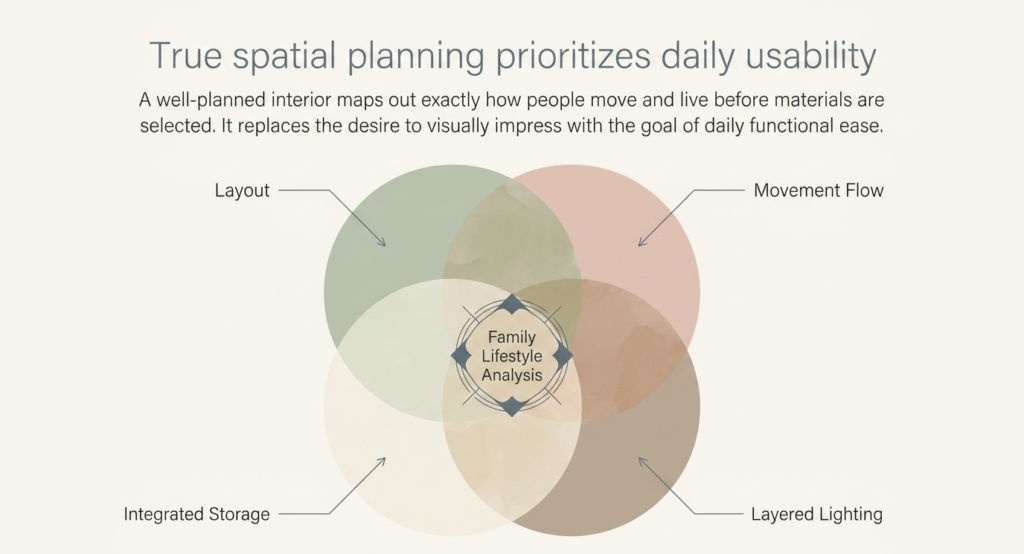
Spatial planning is the process of mapping out exactly how people move through and use every room before furniture or finishes are selected. It involves traffic flow analysis, furniture sizing against actual room dimensions, zoning (separating work, rest, and social areas), and ceiling height considerations.
Most homeowners never see this work. That’s the point. When spatial planning is done well, rooms feel naturally easy to live in. When it’s skipped, you notice the dining chairs scrape the wall every time someone sits down, or the TV is positioned so afternoon sun washes it out.
How storage integration changes everything
Visible clutter is the fastest way to make a luxury home feel cheap. Not because the home is cheap but because storage was never planned for the actual volume of things a family owns.
The solution isn’t more wardrobes. It’s designing storage that’s invisible, accessible, and sufficient from the start:
- Under-bed storage in bedrooms (often 80–100L of usable space per bed)
- Full-height cabinetry that uses dead ceiling space
- Multifunctional furniture in living areas ottomans, storage benches, lift-top coffee tables
- A dedicated utility/linen zone instead of splitting storage across rooms
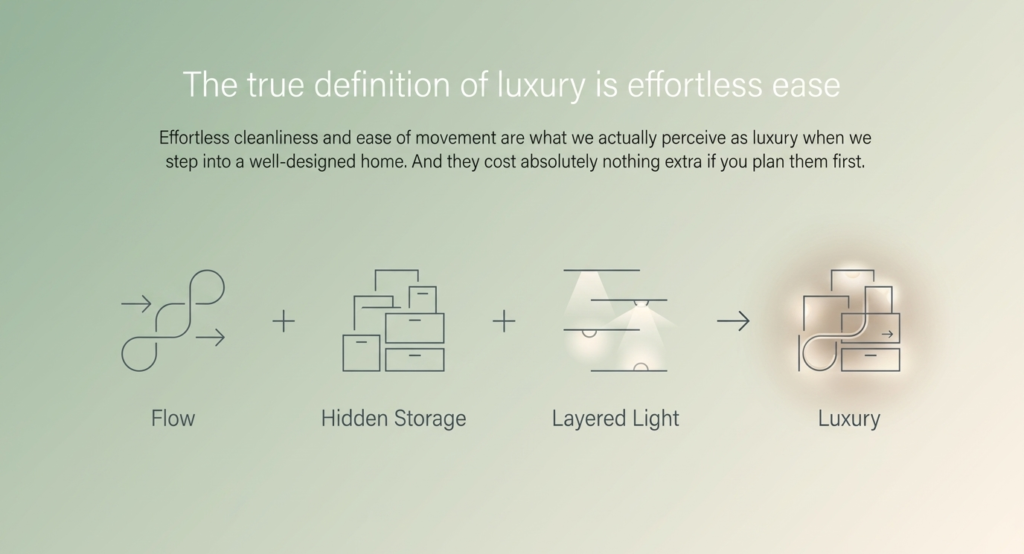
When storage is integrated early, rooms stay clean without effort. That effortless cleanliness is what most people experience as “luxury” when they walk into a well-designed home.
Lighting layout planning: the most underinvested part of any interior
A layered lighting plan typically includes 4 components working together:
- Ambient lighting – the base illumination for a room (usually cove lighting, recessed spots, or soft ceiling panels)
- Task lighting – focused light for reading, cooking, or working (pendant lights above a kitchen counter, a desk lamp, under-cabinet kitchen strips)
- Accent lighting – directional light that highlights a texture, artwork, or architectural detail
- Decorative lighting – the chandeliers and statement fixtures that most people start with
Most homes in India skip the first three and go straight to decorative. The result is a beautiful chandelier in a room that’s either too bright at noon or too dim at 8pm. Dimmers, circuit zoning, and warm color temperatures (2700K–3000K for living spaces) cost very little when planned at the wiring stage. They’re expensive to retrofit.
Does good planning actually save money?
Yes – and not in a marginal way. Poor planning creates 3 types of cost that clients often don’t see coming:
- Rework costs – moving a junction box after tiling is done, relocating a partition wall because the room flow feels wrong, returning furniture that doesn’t fit
- Impulse purchases – buying décor to “fix” a space that actually needs structural changes
- Redesign within 5 years – trend-driven expensive interiors look dated fast; timeless planned ones don’t
In our turnkey projects across Pune and Hyderabad, homeowners who invested in detailed pre-design planning (3–4 weeks of layout, zoning, and lighting work before any procurement) consistently reported fewer change requests mid-project and lower final spend than their initial estimate.
How to know if your interior is planned or just decorated
Ask yourself 5 questions about any room in your home:
- Can 2 people move through the room simultaneously without coordinating?
- Does the lighting change when you need it to (task vs relaxation vs sleep)?
- Is there a dedicated storage place for every category of object in the room?
- Does the furniture fit the room’s scale, or did you choose it from a showroom?
- Would the room feel comfortable at 7am on a Tuesday, or only when guests are over?
If the answers are mostly no, the room was decorated, not planned. The good news: most of these issues can be solved without replacing anything expensive.

Frequently asked questions
Q.1 What is the difference between expensive interiors and well-planned interiors?
Expensive interiors prioritize premium materials, branded furniture, and decorative elements. Well-planned interiors start with spatial analysis, movement flow, storage requirements, and lighting design then select materials that fit within that structure. A well-planned interior on a moderate budget typically outperforms an expensive interior with poor spatial planning on comfort, functionality, and long-term satisfaction.
Q.2 Why do some luxury homes feel uncomfortable to live in?
The most common causes are oversized furniture that blocks traffic flow, single-layer decorative lighting with no ambient or task plan, storage added as an afterthought rather than integrated into the layout, and visual overload from too many competing textures and statement elements. These are planning failures, not budget failures.
Q,3 What is spatial planning in interior design?
Spatial planning is the process of analyzing how people physically move through and use a space then organizing the furniture, storage, and zones around those patterns. It includes traffic flow mapping, furniture scale analysis against room dimensions, zone separation (work, rest, social), and ceiling clearance planning. It happens before material or furniture selection, not after.
Q.4 How important is lighting layout planning in home interiors?
It’s one of the highest-impact and most underinvested parts of any interior. A layered lighting plan ambient, task, accent, and decorative needs to be designed at the wiring stage, because retrofitting circuits and dimmers after tiling is expensive and disruptive. The difference between a room with single-source overhead lighting and one with a proper layered plan is dramatically visible in evening use and mood.
Q.5 Does good interior planning actually reduce the overall cost?
Yes, consistently. Proper planning reduces mid-project change orders (which carry contractor premiums), eliminates impulse décor purchases meant to fix structural problems, and prevents the 3–5 year redesign cycle that trend-driven interiors typically require. In turnkey projects specifically, a 3–4 week planning phase before procurement typically results in fewer overruns and a cleaner final spend.
Q.6 What is a layered lighting approach in interior design?
A layered lighting approach combines at least 3 types of lighting in each room: ambient lighting (base illumination, usually cove or recessed), task lighting (focused light for specific activities like cooking or reading), and accent lighting (directional light on textures or architectural features). Decorative fixtures like chandeliers serve the fourth layer visual interest but can’t replace the first three. Most homes in India are lit only by decorative fixtures, which creates harsh or dim environments depending on time of day.
Q.7 How does storage integration improve interior design?
Storage integrated into the floor plan during design under-bed drawers, full-height cabinetry using ceiling height, built-in utility zones eliminates visible clutter without requiring continuous organizing effort. Visible clutter is the single fastest way to make a premium home feel chaotic. When storage is sufficient and accessible, rooms maintain a calm, organized feel daily, not just when guests are expected.
Q.8 Why are turnkey interior solutions better for luxury home projects?
Turnkey interior solutions place planning, procurement,execution, and installation under a single team, which eliminates the coordination failures that cause most mid-project problems mismatched timelines between civil work and furniture delivery, lighting plans that don’t account for actual wall positions, or finishes that arrive after adjacent work is complete. Xclusive Interiors manages all of this under one contract, which is why turnkey projects consistently deliver cleaner finishes and fewer surprises.
Ready to plan your home properly?
Most homes we walk into for the first time have spent heavily on finishes and underinvested in the 3-4 weeks of spatial planning that determines whether those finishes actually feel good to live with.
At Xclusive Interiors, we start every project with how you move, store, cook, and rest before a single material gets selected. That’s what 18 years and 2,300+ projects across Pune and Hyderabad has taught us to do first.
- A consultation that starts with your lifestyle routines, storage needs, movement patterns not a mood board
- Spatial planning and layout optimization before any procurement begins
- Lighting layout designed at wiring stage, not added as an afterthought
- End-to-end turnkey execution one team, one contract, no coordination gaps