
Smart Home Safety Automation for Kids and Seniors
What Every Indian Family Should Know in 2026
Table of Contents
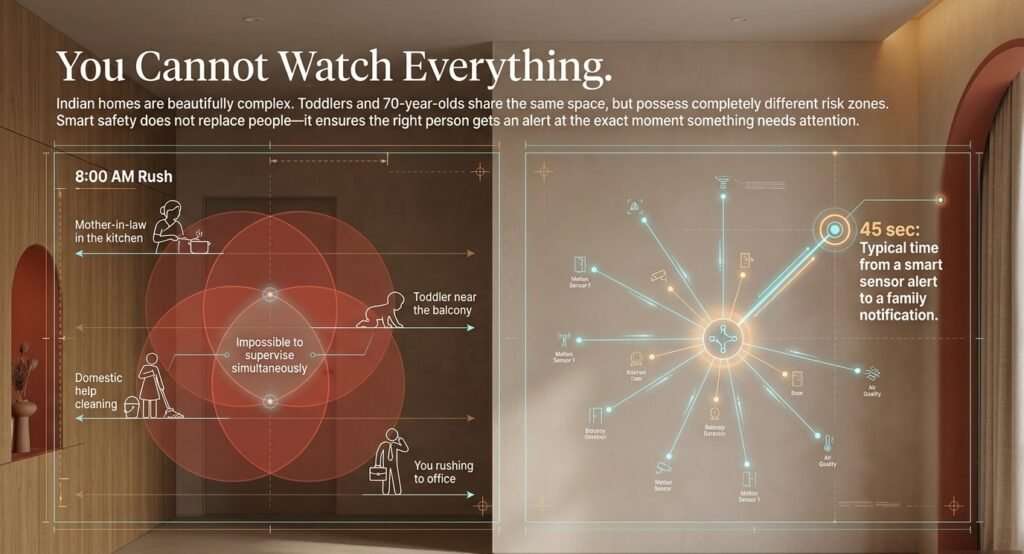
Think about your average weekday morning. You are rushing to office. Your mother-in-law is in the kitchen. Your three-year-old is somewhere between the living room and the balcony. The domestic help is focused on cleaning. Nobody is watching everything at the same time and honestly, nobody can.
That is exactly where smart home safety makes a real difference. It is not about replacing people. It is about making sure the right person gets an alert at the right moment, before something goes wrong.
So in this guide, we will cover everything what devices to use, how much they cost in India in 2026, how to plan your setup, and what actually works versus what sounds good in ads.
First, why do Indian homes need this more than most?
Most Western home safety guides are written for nuclear families two adults, one or two kids, one floor. But that is not how most Indian homes actually work.
We live in the same house as our parents and in-laws. Our children grow up with dadi and nana around. That multi-generational setup is beautiful but it also means you have people with very different needs sharing the same space at the same time. A toddler’s risk zones and a 70-year-old’s risk zones are completely different. And both need attention simultaneously.
On top of that, both parents are often working. You cannot physically watch everything. And domestic help, however trusted, is not trained to handle medical emergencies or fire hazards
| Metric | Insight | Source / Context |
|---|---|---|
| 68% | of senior falls at home happen at night when no one is around | Indian Journal of Orthopaedics |
| 45 seconds | average time for a smart sensor to send an alert to a family member | Smart Home System Benchmark |
| ₹50,000 | starting cost for a basic smart home safety setup in India (2026) | Industry Estimate |
The devices that actually matter and what each one does
There are hundreds of smart home products in the market right now. But for family safety specifically, only a handful of device types actually move the needle. Here is what to focus on.
Gas leak sensors for your kitchen
This one is non-negotiable, especially if you have an older adults cooking alone. LPG leaks are one of the leading causes of home fires in India and the dangerous part is that they often build up slowly, without anyone noticing. A smart gas sensor keeps checking the air continuously. The moment levels cross a safe limit, it sets off an alarm, sends a notification to your phone, and in better models, automatically shuts the gas valve. You do not need to be home for it to act.
Motion sensors near high-risk zones
Not every corner of your home needs a sensor. But staircases, balcony doors, and kitchen entrances do. When a child crosses into one of these areas, the sensor sends an instant alert to your phone. More advanced systems use AI cameras that can actually tell the difference between a child and an adult so you are not getting pinged every time you walk to the kitchen, only when your toddler does.
Smart door locks for restricted rooms
Some rooms are just not safe for children utility areas, home offices with electrical equipment, balconies on higher floors. Smart locks let you control access from your phone. You can lock and unlock remotely, set time-based rules (balcony locked after 7 PM automatically), and get an alert if someone tries to open a locked door. No keys needed, and no chance of forgetting to lock before you leave.
Fall detection for Senior family members
Most falls happen at night. The senior gets up for water or the bathroom, loses balance in the dark, and cannot call for help immediately. Fall detection devices either worn as a pendant or installed as ceiling-mounted radar detect the sudden movement and alert family members within seconds. The radar version is better for seniors who resist wearing devices.
Automated night lighting
This sounds simple, but it prevents more accidents than most people realise. Motion-triggered lights that switch on the moment someone gets out of bed at night mean your elderly parent never has to fumble for a switch in the dark. No action required from them at all.
Smart smoke detectors
The difference between a regular smoke alarm and a smart one is this the regular one alerts whoever is inside the house. The smart one also sends a push notification to your phone, even if you are in office. So if there is a kitchen fire, you know in seconds rather than finding out when a neighbour calls.
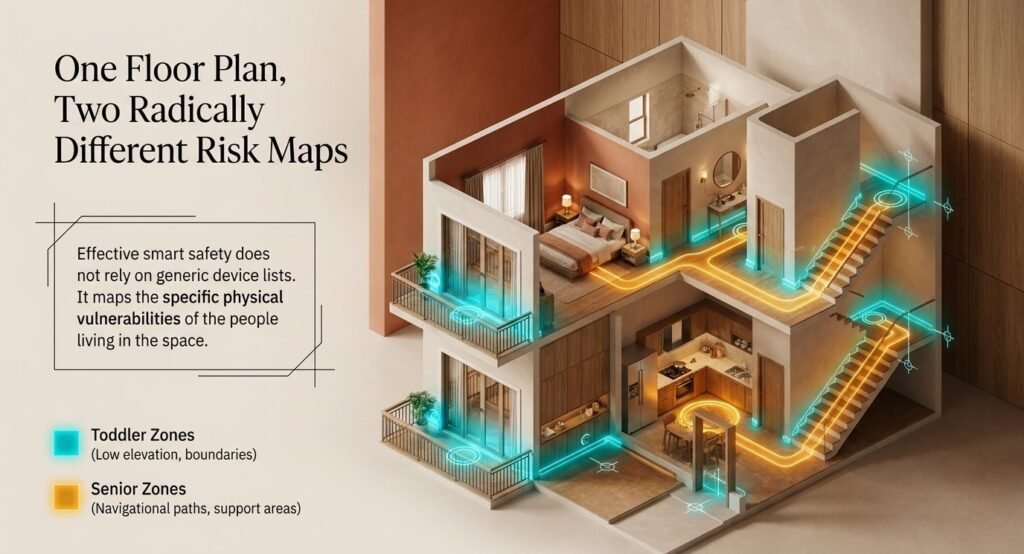
For children: which rooms need attention first?
Balcony
Kitchen
Staircase
Utility / Storage
Power sockets
Main entrance
For seniors: safety should feel like support, not surveillance
This is an important point that often gets missed. When you are setting up smart safety for your parents or in-laws, the goal is not to monitor them. It is to give them and you more confidence. The best systems work silently in the background and only show up when something actually needs attention.
- Fall detection device or ceiling radar — sends an alert within seconds, day or night
- Motion-triggered night lighting — so they never need to find a switch in the dark
- Gas leak sensor with auto valve shutoff — critical if they cook alone
- Emergency alert pendant — one press and it connects to family or a care contact
- Smart smoke and CO detectors — alert goes to family phones, not just the home alarm
One thing we hear consistently from families after setting this up: the Senior person actually feels more independent, not less. They know there is a safety net so they worry less about being alone during the day.
What does AI-based home security actually do differently?
Regular security systems react after something happens. AI systems try to catch it before it becomes a problem.
For example, a standard motion sensor sends an alert whenever there is movement including your ceiling fan or a curtain blowing in the wind. An AI camera, on the other hand, recognises familiar faces. So it alerts you when a stranger is at the door, not every time a family member walks through the living room.
Similarly, AI systems learn your household’s routine over a few weeks. If your father-in-law always moves around the house between 6 AM and 8 AM, and one morning there is no movement by 9 AM, the system flags it. That kind of proactive alert can genuinely make a difference in an emergency situation.
Beyond that, AI smoke detection can distinguish between actual fire smoke and burnt roti which means fewer false alarms and more reliable responses when it actually matters.
How to plan your setup in the right order
You do not need to redo your entire home. A smart, phased approach works well for most families.
- Walk through your home and mark your highest-risk zones first balcony, kitchen, staircase, any room with electrical equipment. These get covered first, before anything else.
- Make a list of the specific people who need protection and their individual risks. A toddler and a senior with knee problems need completely different devices. Do not buy based on a generic list.
- Pick one smart home platform and stick with it. Google Home, Amazon Alexa, or Apple HomeKit just choose one. Mixing brands means multiple apps, poor coordination, and constant troubleshooting.
- Make sure alerts go to at least two family members’ phones. If the primary contact is in a meeting, the second person gets the notification immediately.
- If you are still in the interior design or renovation phase, plan the wiring and sensor placement now. Retrofitting into a finished home is possible but messier and more expensive in the long run.
- Set a monthly reminder to test every device. Check sensors, replace batteries, confirm the alerts reach your phone. Ten minutes once a month is all it takes.
Smart Home Safety System Costs in India (2026)
| Setup Level | What You Get | Estimated Cost | Best Suited For |
|---|---|---|---|
| Basic | 2–3 sensors, 1 smart lock, gas detector | ₹50,000 – ₹75,000 | 1–2 BHK homes, covering primary risk zones only |
| Mid-Range | Full-home sensors, AI cameras, fall detection | ₹75,000 – ₹1.2 Lakhs | 2–3 BHK homes with children or senior citizens |
| Premium AI | Full integration, AI behaviour monitoring, automation | ₹1.2 – ₹2.5 Lakhs | 3 BHK+ homes, villas, multi-generational families |
Cost estimates based on project data from Xclusive Interior across Pune (2024–2026).
Why built-in always beats bolt-on
Retrofitting smart devices into a finished home works but there are always trade-offs. Wires run along the skirting board. Sensor housings look added-on. In some cases you need to reopen walls for proper cable routing, which means replastering and repainting entire sections afterward.
The better approach and what Xclusive Interior does on every project is to plan the smart safety infrastructure during the interior design stage itself. Conduits go into walls before plastering. Sensor locations are decided alongside the ceiling and lighting plan. The result is a home where all the technology is completely invisible. It just works, from day one, without anything looking like an afterthought.
Across completed projects in Hinjewadi, Kharadi, Baner, and Wakad, this integrated approach has consistently delivered cleaner finishes and more reliable coverage than any retrofit setup we have seen.
Frequently asked questions
Q. What exactly is smart home safety automation?
Simply put, it is a group of connected devices sensors, smart locks, cameras, and alert systems that monitor your home and respond to risks automatically. You do not have to watch everything yourself. The system does it, and tells you immediately when something needs your attention.
The most useful devices for Indian families:
- Gas leak sensors with auto valve shutoff in the kitchen
- Motion sensors near balconies, staircases, and kitchen entrances
- Smart door locks for restricted rooms, controlled from your phone
- Fall detection for elderly residents wearable or ceiling radar
- Smart smoke detectors that alert your phone, not just the room alarm
Q. How do motion sensors actually protect children?
They detect when a child enters a dangerous zone like the balcony or the top of the staircase and immediately send a notification to your phone. You get the alert before anything happens, not after. Advanced AI camera setups go further and can tell the difference between a child and an adult, so you are not getting false alerts every time you walk past the same spot.
Q. Which fall detection device works best for seniors in India?
For seniors who are willing to wear something a pendant or watch-style wearable is the most reliable. It detects sudden movement changes and sends an alert within seconds.
For seniors who refuse to wear a device ceiling-mounted radar is the better option. It monitors the room passively without them needing to do anything at all.
Either way, make sure the alert goes to at least two family contacts, not just one so that if the primary contact is unavailable, someone else gets the notification straight away.
Q. Is all this really affordable for a regular Indian family?
Yes, more than most people think. You do not need to buy everything at once. A basic setup covering your kitchen and two or three high-risk zones costs around ₹50,000 to ₹75,000. That is a one-time expense, and as we mentioned earlier, some insurance companies actually reduce your home policy premium once you have certified smart safety devices installed. So the net cost over five years is lower than the sticker price suggests.
Q. Will these devices work during a power cut or if the internet goes down?
Local devices gas detectors, smoke alarms, basic motion sensors continue working and sounding audible alarms even without internet or power (with battery backup). However, smartphone alerts, AI camera features, and remote monitoring do need an active internet connection. A simple fix is to put your router on a small UPS that way your internet stays up during the short power cuts that are common in many Pune areas.
Q. Can I add these devices to my existing home or only during construction?
You can definitely add them to an existing home most modern devices are wireless and install without major work. That said, the result is always a bit of a compromise. Wires are visible, sensor placement is limited by your existing walls, and hub locations depend on where your power points already are. If you are planning a renovation or getting a new home done, that is the ideal time to plan smart safety alongside the interior design so everything is built in from the start and nothing looks added on afterward.
Q. Does Xclusive Interior handle smart home safety in Pune?
Yes. Xclusive Interior one of the best interior designers in Pune integrates smart home safety systems as part of every full interior design project across Hinjewadi, Kharadi, Baner, Wakad, Balewadi, and Aundh. Instead of adding devices to a finished home, the team plans sensor locations, conduit routing, and hub placement during the design phase itself so everything is concealed, coordinated, and working from the day you move in.