
Home Interior Planning: Week 1 Decides Everything
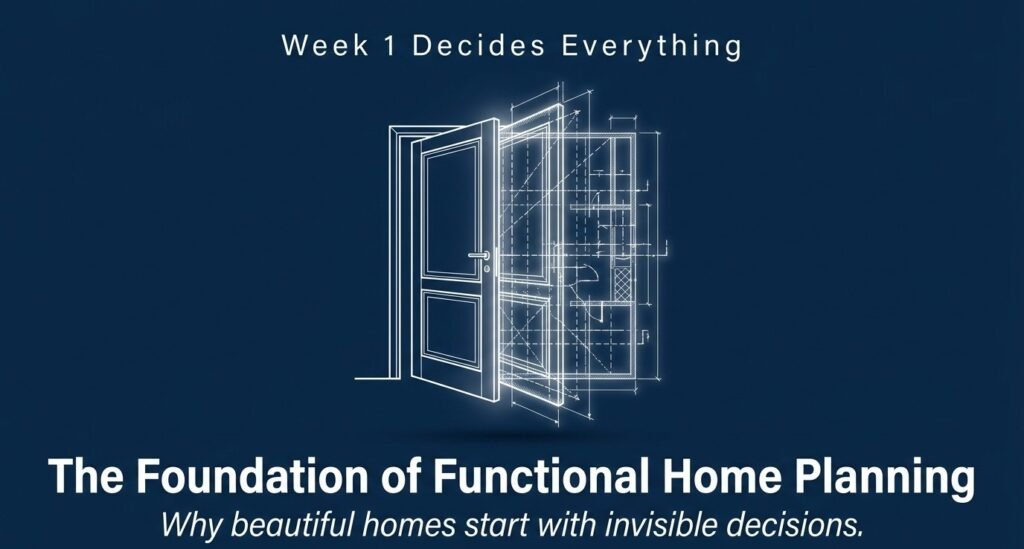
Home interior planning is the phase most homeowners never see and most budget designers quietly skip.
It happens before demolition. Before tile selection. Before you’ve argued about which shade of white the walls should be.
Done right, it’s why some homes feel effortless to live in five years later. Done wrong, it’s why a drawer hits the door every morning.
What home interior planning actually is
Home interior planning is the process of mapping how a space will function before any construction begins. It covers space layout, traffic flow, electrical and lighting zones, false ceiling coordination, and storage allocation.
This isn’t the same as interior design. Design is the aesthetic layer: colours, materials, furniture. Planning is the structural and functional foundation underneath it.
Most problems people face in a finished home trace back to the planning phase, not the design phase.
The work that happens before your designer picks a single finish
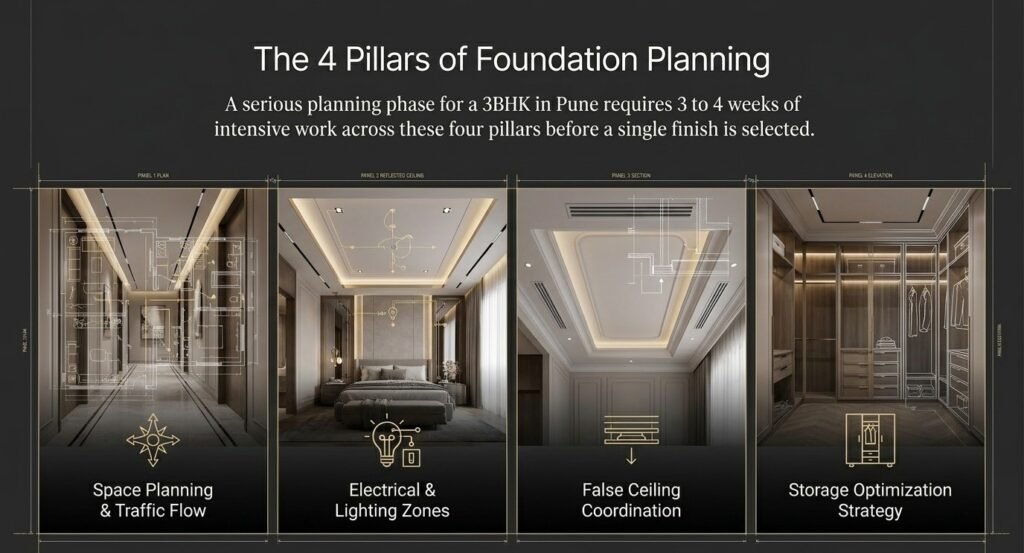
A serious planning phase for a 3BHK in Pune runs 3 to 4 weeks. Here’s what actually gets resolved in that time.
Space planning and traffic flow
Your designer maps how people physically move through each room. Door swings, furniture clearances, the natural walking path from the entrance to the kitchen at 7am when half the family is still asleep.
Get this wrong and a 1,400 sq ft apartment feels cramped by year one. Get it right and a 900 sq ft flat feels generous.
Electrical and lighting zones
This decision has to be made before the walls close. Once electrical conduit is run, you’re locked in for the life of the apartment.
Good lighting requires layered zones: ambient for the room, task for work surfaces, accent for architecture. These need separate circuits and switch positions planned on paper first, not decided when the electrician is already on-site.
A luxury interior designer in Pune who’s done this on 50+ Pune apartments knows that west-facing units in Baner and Wakad get direct afternoon sun from 2pm onwards. That affects where you place artificial light sources, not just where you put curtains.
False ceiling coordination
In most Pune apartments, false ceilings hide AC ducts, electrical conduit, and sometimes structural beams. Your designer coordinates with MEP consultants to align ceiling height, cove details, and fixture placement before any civil work begins.
This coordination happens on paper. Trying to sort it out on site adds cost, delays, and usually forces a compromise somewhere.
Storage planning for home
Most homes in Pune run out of storage by year two. A proper home interior planning phase starts with a storage audit: what you own now, what you’ll likely accumulate, and how frequently you access different categories.
This shapes kitchen cabinet depth, wardrobe configurations, loft allocations, and whether you need a dedicated utility space or can fold it into an existing room.
What goes wrong when this phase gets skipped
These are patterns that show up repeatedly in renovation projects.
A sofa arrives and blocks the balcony door. The AC unit in the master bedroom sits directly above the bed because nobody mapped the duct routing early. The kitchen has 12 overhead cabinets but no counter space near the hob. The main bathroom door swings into the commode.
None of these are design failures. They’re planning failures. And fixing them after handover costs 3x what they would have cost to solve on paper.
How Xclusive Interiors handles the planning phase
Xclusive Interiors runs a formal planning phase before any finish selection begins. Their team maps space layout, coordinates electrical and civil requirements, and documents scope before a single vendor quote goes out.
Their projects across 18+ years include apartments in Kondapur, Baner, Kalyani Nagar, and Wakad. That site experience means their planners know where Pune’s common structural constraints show up and how to work around them without blowing the budget.
Their carpentry comes with a 10-year warranty, details of which are covered in their project agreements. If you want to understand what the full investment looks like, Xclusive Interiors has a detailed cost breakdown that covers consultancy through to handover.
One question worth asking any designer before you hire
Ask to see the space planning document from a previous client project. Any experienced designer has these and will share an anonymised version. If they can’t produce one, the planning phase probably doesn’t exist the way they’re describing it.
This one question cuts through 80% of the noise in shortlisting conversations.
What a well-planned home actually delivers
A bedroom where the AC unit, blackout curtain track, and door swing were coordinated before the plumber arrived is a bedroom you’ll sleep well in for 20 years without thinking about changing.
That’s the real goal of home interior planning. A home where nothing fights you.
Q1. What is home interior planning ?
Home interior planning is the phase where a designer maps the functional decisions for a space before any construction begins. It covers space layout, electrical and lighting zones, storage allocation, false ceiling coordination, and traffic flow. It happens before design decisions like colours and materials.
Q2. When should home interior planning start?
Before demolition. Ideally 4 to 6 weeks before any civil work begins. Electrical planning especially needs to happen before walls close, since moving conduit after the fact is expensive and often structurally impossible in older Pune apartments.
Q3. What does a home interior planning phase include?
A complete planning phase covers space layout, furniture placement, door and window coordination, electrical and lighting zone mapping, AC and duct routing, false ceiling structure, and a storage audit. Some firms also include MEP coordination at this stage.
Q4. How long does home interior planning take?
For a standard 3BHK in Pune, expect 3 to 4 weeks. Larger homes, unusual layouts, or apartments with load-bearing walls that require structural workarounds take longer. Skipping this phase to save time usually adds 4 to 8 weeks to the execution phase through rework.
Q5. Can I do home interior planning without a professional designer?
You can handle furniture layout and storage planning yourself with a decent floor plan. But electrical coordination and MEP integration need a designer with site experience. Getting this wrong costs more to fix than the consultancy fee.
Q6. What happens if you skip the planning phase?
The problems show up 6 to 12 months after handover. Storage runs out faster than expected. Traffic patterns get awkward in rooms that seemed fine in photos. Lighting feels flat because zones weren’t thought through. These are rarely fixable without partially redoing the space.
Q7. What's the difference between interior planning and interior design?
Planning deals with structure and function: how the space works. Design deals with aesthetics: how the space looks. Most design problems that show up after a project is finished are actually planning problems. The best designers treat these as one continuous process, not two separate services.
Your home’s biggest decisions happen before work starts
Good home interior planning is why some homes age well and others feel dated or awkward within a few years. The decisions made on paper in the first few weeks determine almost everything that follows.
If you’re planning a renovation in Pune and want a team that starts with how you live before recommending what anything should look like, talk to Xclusive Interiors.
18+ years. 2,300+ projects. A planning-first process built for homes that actually work.