
Interior design ideas for apartments look great on Pinterest. In real Pune flats, most of them backfire.
Over 10+ years designing compact 2BHKs and 3BHKs across Baner, Wakad, Kharadi, and Hyderabad, we’ve walked into the same problems dozens of times. Oversized sofas blocking circulation. Low ceilings made worse by the wrong lighting. Wardrobes that stop at 7 feet when the ceiling goes to 10.
This article is built on those real projects, not design theory.
Here are the 7 mistakes we see most often, and exactly how we fix them
What Are the Biggest Interior Design Mistakes in Apartments?
The most common mistakes in apartment interior design are: oversized furniture that kills circulation, ignoring vertical storage, poor lighting layering, undefined zones in open layouts, wrong flooring choices, and skipping a design plan before buying anything. Each one shrinks your space visually and practically.
Mistake 1 – Furniture That’s Too Big for the Room
This is the number 1 problem we see. Every time.
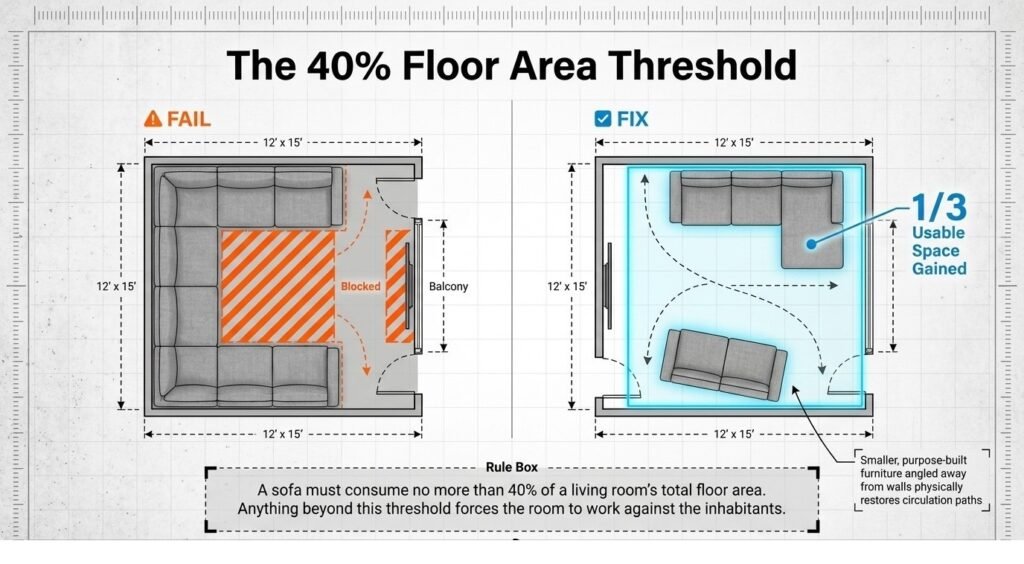
In one 2BHK project in Baner, the clients had a 7-seater L-shaped sofa in a 180 sq ft living room. It looked fine in the showroom. In the flat, it reduced the circulation path to about 18 inches. You had to turn sideways to walk to the balcony.
We replaced it with a modular 4-seater with a chaise, angled slightly away from the TV wall. The room gained back almost a third of its usable floor space.
The rule we use: your sofa should take up no more than 40% of the floor area in a living room. Anything beyond that and the room starts working against you.
Smaller, purpose-built furniture almost always wins in apartments.
Mistake 2 – Ignoring Vertical Space
Most apartment owners think horizontally. Storage units that are 6 feet tall. TV units that spread across the wall at floor level. Wardrobes that stop 2 feet short of the ceiling.
That dead space above 7 feet? We use all of it.
In compact Pune apartments, we extend wardrobes to full ceiling height and integrate loft storage above passage doors. In one Wakad project, this added over 40 sq ft of storage to a flat that the clients thought had “no space left.” They hadn’t looked up.
Wall-mounted shelving, overhead kitchen cabinets, loft beds in kids’ rooms vertical thinking changes the math completely.
Mistake 3 – Treating Lighting as an Afterthought
A single ceiling light in the center of the room is the most common lighting mistake in Indian apartments.
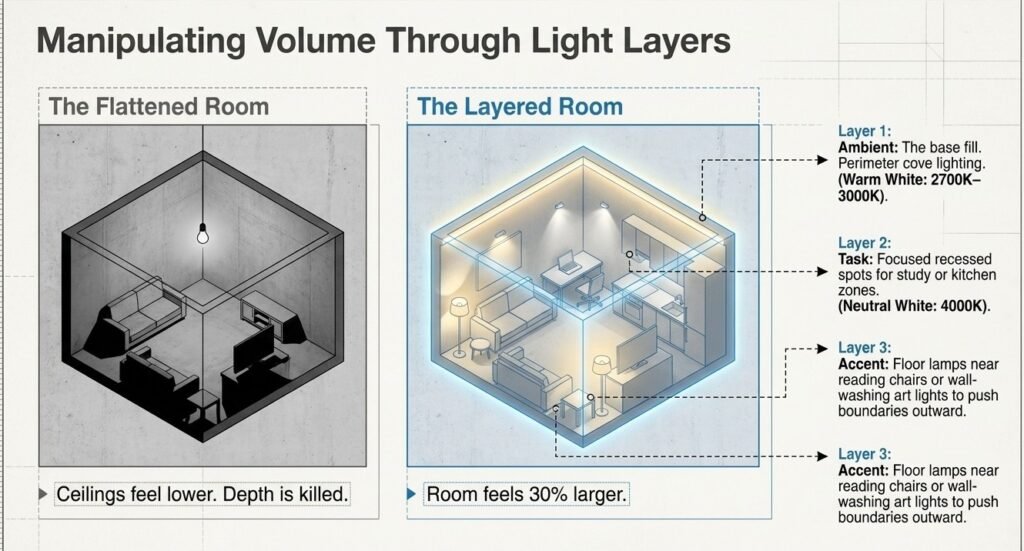
It flattens everything. Makes ceilings feel lower. Kills depth.
Layered lighting does the opposite. We typically plan 3 layers for every room:
- Ambient (the base fill, usually recessed or cove)
- Task (focused light where you work or cook)
- Accent (wall-washing, shelf lighting, art lights)
In a Kharadi project, the living room felt dark and heavy even with a 6-light chandelier. We replaced it with perimeter cove lighting plus 4 recessed spots and a floor lamp near the reading chair. The room looked 30% larger. Nothing moved. Only the light changed.
Warm white (2700K–3000K) for living areas and bedrooms. Neutral white (4000K) for kitchens and study zones. This alone makes a measurable difference.
Mistake 4 – Open Plans With No Defined Zones
Open-plan layouts feel modern until the living, dining, and kitchen bleed into each other with no visual logic. Then it just feels chaotic.
We use 4 tools to define zones without walls:
- Rugs — the fastest way to anchor a seating area and say “this space belongs here”
- Ceiling treatment changes — a dropped panel or cove over the dining area separates it from the living without a partition
- Furniture orientation — turning the sofa slightly inward creates enclosure
- Material shifts — tile in the kitchen, wood-look in the dining, carpet texture in the living
In a 1200 sq ft flat in Viman Nagar, the entire open area felt like one large corridor. After zone definition (rug, dropped ceiling panel, and a half-height storage unit as a soft divider), 3 distinct rooms existed in the same space. The clients said it felt like a bigger flat, even though nothing was added.
Mistake 5 – Wrong Flooring Choices for Small Spaces
Large format tiles (800x800mm or bigger) in a small apartment make the floor feel continuous and open. Smaller tiles create more grout lines, which visually fragment the space and make it feel busier.
We also see a lot of dark wood flooring in compact apartments. It looks rich in isolation. With small windows and low ceilings, it absorbs light and makes the flat feel like a basement.
Light, warm-toned floors in matte or satin finish work best for apartments under 1000 sq ft. Save the dramatic dark wood for larger homes where you have the volume to absorb it.
Mistake 6 – Skipping Storage Planning Until the End
Storage is not a finishing detail. It’s a structural decision.
When storage gets planned last, it gets shoehorned in. Extra cabinets get added wherever there’s wall space. The result looks busy and still doesn’t work well.
We plan storage in the first design meeting, before any furniture is selected. We map where everything the family owns will live: clothes, shoes, kitchen inventory, cleaning equipment, books, kids’ toys, guest bedding. Then we design around that map.
In most Pune apartments, this exercise reveals that 20–30% of storage needs are currently being met by the main rooms because utility areas and passages weren’t designed to carry load. Fix the layout, and the living spaces clear up on their own.
Mistake 7 – Buying Furniture Before Finalizing the Design
This happens constantly, especially during the construction phase. Clients walk through a mall, see a sofa they love, and buy it on the spot. Then the interior design plan comes in, and the sofa doesn’t fit, clashes with the material palette, or blocks a window we needed open.
We’ve had to work around 3 pre-bought sofas in the last year alone. One of them forced the entire furniture layout 90 degrees because of where it sat relative to the balcony door.
The sequence matters: design first, buy second. Even a basic floor plan with dimensions saves you from expensive mistakes.
What Makes Xclusive Interiors Different for Apartment Projects?
We don’t work from templates. Every project starts with a site visit, a proper measurement drawing, and a conversation about how the family actually lives.
Xclusive Interiors has delivered 2300+ apartment and commercial projects across Pune and Hyderabad. Our clients include compact 1BHK redesigns and full luxury 4BHK builds. The process is the same: solve the real problem first, then make it beautiful.
Our typical apartment project timeline runs 45–60 days from design sign-off to handover. We handle everything in-house: design, material sourcing, execution, and snagging.
Ready to Get Your Apartment Interior Design Right?
Most interior design ideas for apartments fail in execution, not concept. The difference is a team that’s done it before, in real Pune flats, with real constraints.
Xclusive Interiors has 10+ years of apartment projects across Pune and Hyderabad. We’d love to walk through your space.